This past week, our class participated in a district-wide writing assessment. As I looked through the papers, I kept seeing the same spelling errors — “mi” instead of “my,” “ski” instead of “sky.” And I had to be honest with myself: had I ever actually taught Y as a vowel explicitly? Not really. I had mentioned it. We had talked about it in passing. But had I given it its own lesson, its own practice, its own place in our phonics sequence? No. And I was making a personal decision to change that.t I am making personal decisions to fix that.
Teaching Y as a vowel is one of those skills that tends to fall through the cracks of our literacy programs, yet it shows up constantly in early reading and writing. I think part of the reason it gets skipped is that many of us aren’t fully sure of the rule ourselves. Did you know that Y functions as a vowel 97% of the time? We teach children to say “a, e, i, o, u — and sometimes y,” but the truth is, Y is almost always a vowel. It just doesn’t always get treated like one. a vowel 97% of the time. Saying a, e, i, o, u sounds easier but we need a new saying to fit y into the mix.
When Should We Teach Y As A Vowel?
This is where it can get a little tricky. Y can say long I, long E, and even short I — but in the primary grades, we rarely encounter short I in everyday texts (words like gym and mystery will pop on occasion). For now, I’d recommend focusing on long I and long E, which is where Y shows up most in the books and writing our K-2 students are working with.
As for timing, most teachers introduce this concept after short vowels and CVC words are solid. If your school uses UFLI Foundations, it’s introduced after CVCe (long vowel, silent e) words. Either way, this is not a concept to rush — make sure students have a good foundation first.
The Simple Rule Students Need
Here’s the good news: the rule really is simple.
When Y is at the end of a word and it’s on its own — meaning there’s no other vowel alongside it — it steals a vowel sound. In one-syllable words (fly, my, sky, cry), Y says long I. In two-or-more syllable words (happy, funny, baby, silly), Y says long E.
That’s it. Once students hear it that way, it tends to click.
I like to call Y “the copycat” — it sneaks to the end of a word and borrows another vowel’s sound. Primary kids love this kind of language, and it gives them something memorable to hold onto.
How do you teach Y as a Vowel?
Glad you asked! I always start with a shared story. I project it on the screen and we read it together the first time just for enjoyment — no agenda, no circling, just the story. Then we go back through it a second time, and that’s when the real work begins (see image of the first story below).
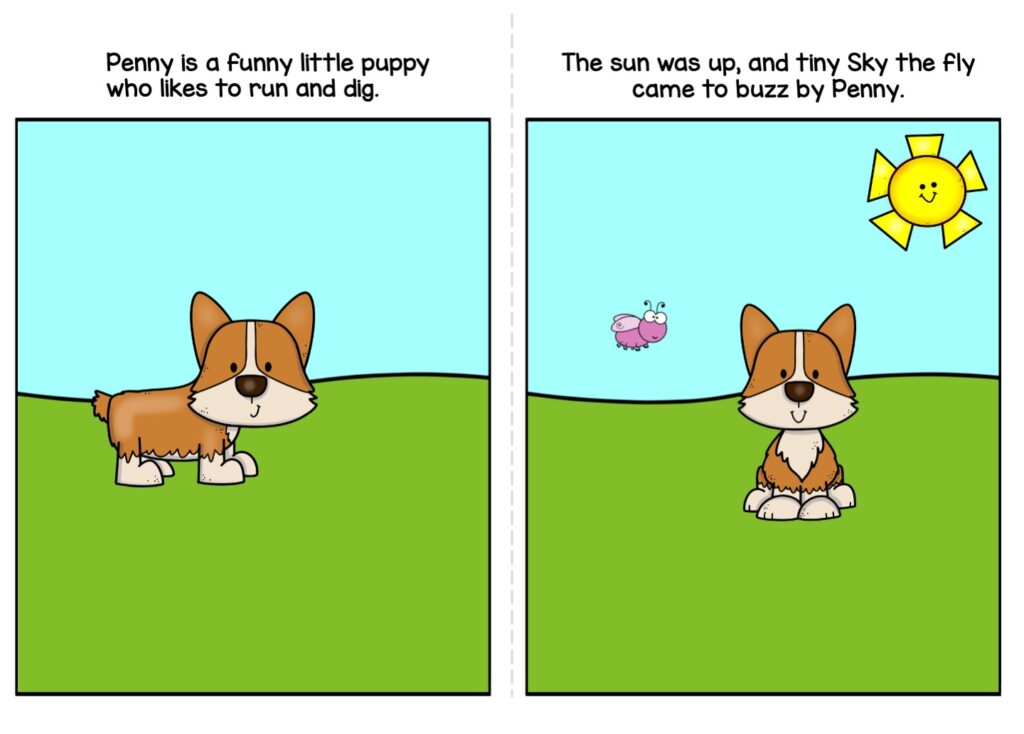
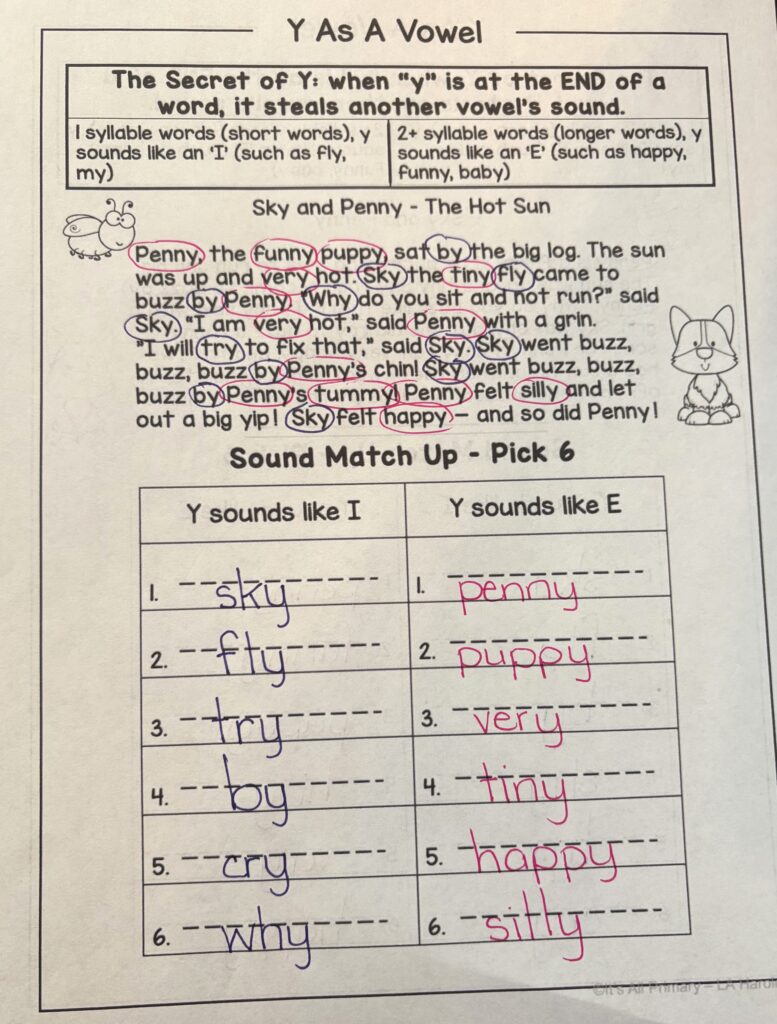
Students each have a copy of the story, and I ask them to find and circle every word that ends in Y — using two different colours. One colour for words where Y says long I, another for words where Y says long E. The two-colour approach makes sorting so much easier, and honestly, it slows students down in the best way. They have to think about each word before they circle it.
From there, we build a T-chart together on the board, students share what they found, and then they complete a Sound Match Up on their worksheet. This can be optional depending on the abilities of your students. Students can fill in their worksheet independently or as a class (see image below).
I also include a Y-Swap activity that my students love — you start with a word, swap one letter, and build a new word. It works beautifully with magnetic letters if you have them.
Taking it Further
Once students have had some practice with the concept, I love to send them on a little hunt. During our “book look” time — when students are browsing and reading independently — I’ll ask them to keep an eye out for words ending in Y and think about which sound it’s making. It’s a low-pressure way to reinforce the skill in a real reading context, and students get genuinely excited when they find one. They enjoy being sound detectives! It also sends a quiet but important message: the things we learn in our phonics lessons show up in real books. That connection matters.
Are You Needing A Resouce To Teach Y As A Vowel?
If you’d like a ready-to-go version of everything I described — the Sky and Penny stories, the worksheets, the Y-Swap activity, 2 Read & Find activities, and an editable lesson plan — you can find my Y as a Vowel resource in my TPT store. It’s print-and-go, and it’s designed to work for your whole class with easy differentiation built in.
Y as a vowel is one of those small but mighty phonics lessons that pays off quickly — in spelling, in reading, in writing, and in the confidence students feel when they start noticing it everywhere. It doesn’t need to be complicated. It just needs to be taught.
Happy Teaching!
Lori-Anne

Leave a Reply
You must be logged in to post a comment.