Wow, these last couple months are flying by. We are already at assessments for the final report cards. In our school district, first grade students don’t need to know numbers to 120, but we like to introduce it to them so that they are deer in headlights come September. Using 120 charts is an easy way to reinforce number sense why provide more engaging activities for your students.
Why the 120 Chart
If you have a calendar wall, chances are you already have a number chart hanging right there in your classroom. That chart is doing more work than you might think! The 120 chart is a powerful visual tool because students can see the patterns — tens, skip counting, number relationships — rather than just memorizing abstract facts. When numbers are laid out in rows and columns, even our youngest learners begin to notice things on their own. That kind of discovery builds real number sense.
How We Use It
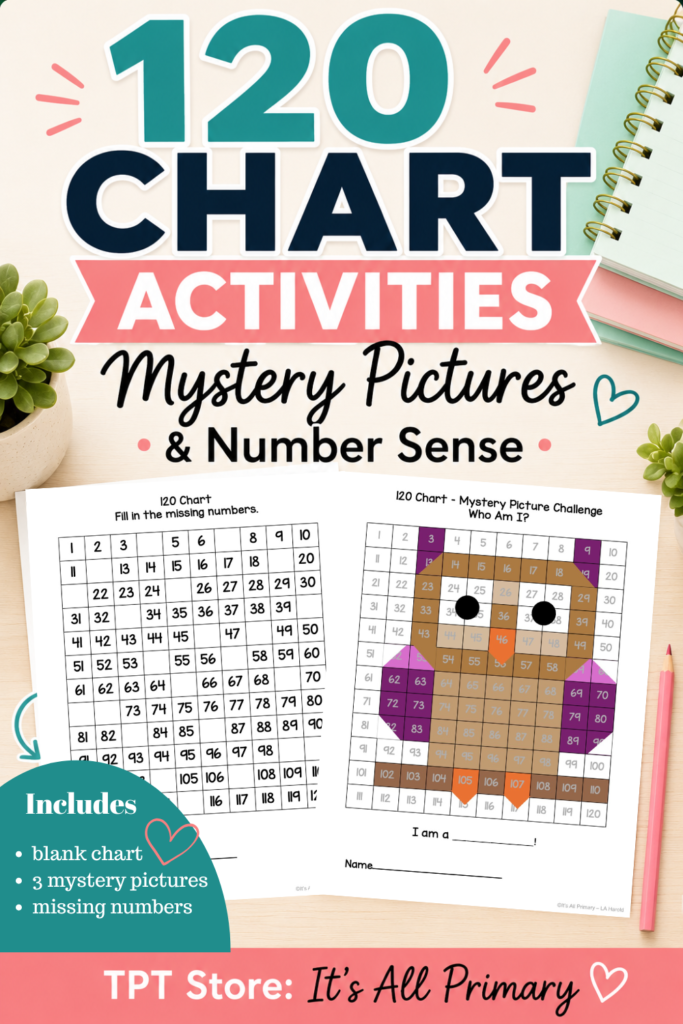
We don’t dig into formal 120 chart activities until closer to the end of the year — it’s one of those end-of-year gems. When we are ready, we start as a whole class. I model how to complete a mystery picture together on the projector, and the kids love the reveal moment when the picture appears. It feels like a game, not a math worksheet.
Once students have the hang of it, the extra activities are perfect for early finishers. No scrambling for something meaningful to do — they go straight to the next mystery picture and get right back to work.
Another reason why I like these type of activities is that I often have students who are past the numbers expected in our school district. They want to do something meaningful and the mystery pictures are a “win”. I plan on creating a few more to have on hand.
What Students Are Actually Practicing
It might look like colouring, but there is so much happening underneath. As students navigate the chart to find and fill in numbers, they are reinforcing one-to-one correspondence, recognizing number patterns, and building confidence with numbers beyond 100. Many students start to notice on their own that the numbers in each column share something — that tens digit is a clue! Others begin skip counting without being prompted because the chart makes it so visual and intuitive.
The missing number activities add another layer. Instead of just finding a number, students have to think about what comes before and after, which strengthens their understanding of number order and sequence. It’s a quiet but mighty review of so many first grade number sense skills all wrapped up in one activity.
Grab a Ready-Made Resource
If you want a no-prep way to bring 120 charts to life in your classroom, I have a set of 120 Chart Activities — Mystery Pictures and Missing Numbers — ready for you in my TPT store. Your students will be practicing number sense to 120 without even realizing they are doing math!
If you are new to teaching, there are several blog posts on teaching math, including this Guide post. I go through the basics of starting primary math.
Happy Teaching!
Lori-Anne

Leave a Reply
You must be logged in to post a comment.